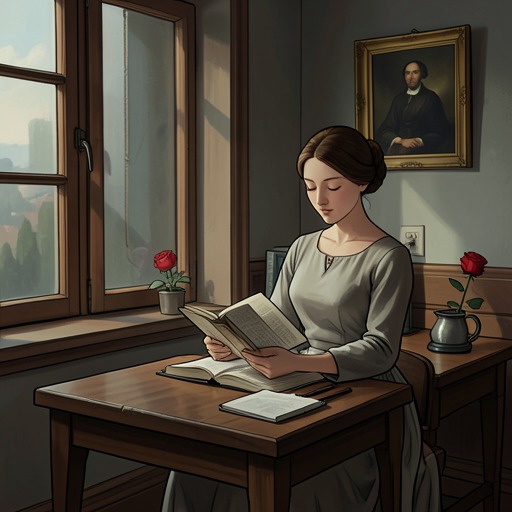
The Christmas rose as an emblem of the heart
The Tenant of Wildfell HallThe Christmas rose as an emblem of the heart is the image through which Helen Graham makes her feelings for Gilbert Markham legible without reducing them to a simple promise of immediate marriage. A flower that survives winter becomes a figure for a heart preserved through hardship, and its gift marks the movement from separation and uncertainty toward a possible future together.
The flower and its meaning
Helen draws attention to the rose’s difference from a summer flower: it is less fragrant, yet has endured conditions that would have defeated more delicate blooms. She describes winter rain as its nourishment and faint sunlight as its warmth; neither bleak winds nor frost has broken its stem or blighted it. Even with snow on its petals, it remains fresh and blooming. The comparison makes survival, rather than untroubled beauty, the basis of the emblem.
The rose’s meaning is not left to inference alone. When Helen offers it to Gilbert, she asks whether he will take it; later she explains directly that it was an emblem of her heart. Its resilience thus represents her own capacity to continue through sorrow and difficulty without losing the possibility of love. The image does not erase what she has suffered: the flower’s endurance is precisely what gives the gift its force.
A declaration made through a gift
The exchange unfolds through gesture as well as speech. Gilbert holds out his hand, unable to speak for fear that emotion will overcome him, and Helen lays the rose across his palm. He scarcely closes his fingers around it, absorbed in wondering what her words mean. The flower first carries a message that neither has yet fully stated, allowing the scene to dwell in uncertainty before Helen clarifies its significance.
When she calls the rose an emblem of her heart, Helen frames the gift as a question about whether Gilbert will accept her and leave her no longer alone. The exchange is reciprocal: she gives him the flower as a sign of her feeling, while his response is to ask whether she would also give him her hand in marriage. Her smiling answer indicates that she has said enough. The movement from rose to hand makes the emblem a step toward commitment, rather than an ornamental image detached from their relationship.
Hope shaped by loss and time
The rose’s promise carries the history of the obstacles between them. Earlier, Helen refuses to let Gilbert make their hopes depend upon Arthur Huntingdon’s death. She calls such hope morally wrong and practically uncertain: Arthur might live for many years, leaving Gilbert to wait through much of his youth for a future that might never come. Helen also points to the cost of that waiting for herself, imagining that hardship could leave her worn by the time such a future arrived.
Her circumstances had already shown how restricted her choices were. When she asks Arthur to let her take their child and what remains of her fortune and go, he refuses; he will neither let her leave with the child nor separate from the child himself. Helen concludes that they will henceforth be husband and wife only in name. In that context, the winter rose’s endurance offers no instant escape or uncomplicated resolution. It gives form instead to a love that has survived separation and uncertainty, while the possibility of a shared future depends on circumstances Helen cannot simply will away.
The emblem’s place in the ending
The narrative later reports that, some time before Arthur’s death, Lady Lowborough eloped with another man and eventually fell into difficulty and debt. That brief account places the rose scene within a wider story of relationships shaped by hardship and consequence, but it does not make the flower a general promise of happiness. Its meaning remains specifically tied to Helen’s declaration and Gilbert’s acceptance of the offered sign.
As a winter bloom, the rose brings the season’s adversity into the couple’s exchange without turning endurance into mere ornament. Its snow-covered petals belong to the image Helen presents; its symbolic meaning is secured by her own explanation. The scene therefore joins the emotional climax to a concrete object: a flower that has survived is placed in Gilbert’s hand, and its survival becomes the language in which Helen can offer him her heart.